It took a few years, but we are re-energized. The coming year looks to be a good one.
We are very happy to welcome ceramic artist Veronica Byun to our department as Artist in Residence. She brings a wealth of experience and knowledge in ceramic sculpture. Originally from Seoul, Korea, Veronica is currently based in New Jersey. Her education includes degrees from Alfred, RISD and post Baccalaureate work at Syracuse University.
She has exhibited in numerous national and international exhibitions including the "54th Premio Faenza International Ceramic Art Competition," in Italy, the Taiwan Ceramics Biennale 2008, in Taipei, Taiwan and "World Women: On the Horizon," at the Baltimore Clayworks, in Maryland. She is represented by Loveed Gallery, in New York City.
Awards include residencies at Guldagergard Ceramic Research Center, Denmark, PrattMWP, and a New Jersey State Council on the Arts Fellowship. Her work has been reviewed in numerous publications including Ceramics Monthly, Ceramics Art and Perception and The Philadelpia Enquirer.
This fall Veronica is teaching a ceramic sculpture course in our continuing education division and will be conducting a mold making workshop in November (more to come on that).
We welcome Veronica and are excited to be working with her. We will be posting images of her work in the near future. In the meantime you may go to the link below...
www.veronicabyun.com
Saturday, September 14, 2013

Tuesday, April 16, 2013
The itinerary for the June workshop will be-
Friday AM- Demonstration of throwing a vase for surface decoration; discussion of engobes for use in salt. Slides in the evening.
Friday Afternoon- Demo of bottles and other forms with the use of applique, stamping and color for salt.
Saturday- Demonstration of larger forms for firing in salt. Ideas for experimentation; Slides of my work in the evening.
Sunday- Workday
Following Friday- glaze and load kiln.
Saturday- Fire kiln with salting party in the evening.
Sunday Evening- Kiln opening and critique.
Exact times for the above will be provided to students once course is assured of running.
Saturday, March 2, 2013
Spring Firings- Salt Is In The Air

 |
| Salt Vapor Shrouds the Campus Photo by Nancy L. Ford |
We are again offering a June Workshop. We will be exploring the use of color and surface fired in a salt kiln. More information and the itinerary for the workshop will be posted in April. For now, stay warm! I am kicking around the idea of including a second firing of some work for the surface effects as seen in the piece below.
 |
| Salt Fired Bowl- refired at ∆10 Reduction for Carbon Luster |
Friday, February 15, 2013
Brooklyn Fire
We just received news of the devastating fire last night on the Pratt Brooklyn campus. We don't know exactly what this means for those students who lost work or for that matter how long it will take for the campus to recover. We on the upstate campus are ready to help in any way...
Friday, July 27, 2012
Vapor
 |
| the Altar |
Wednesday, May 23, 2012
What we did
 |
| The PrattMWP anagama |
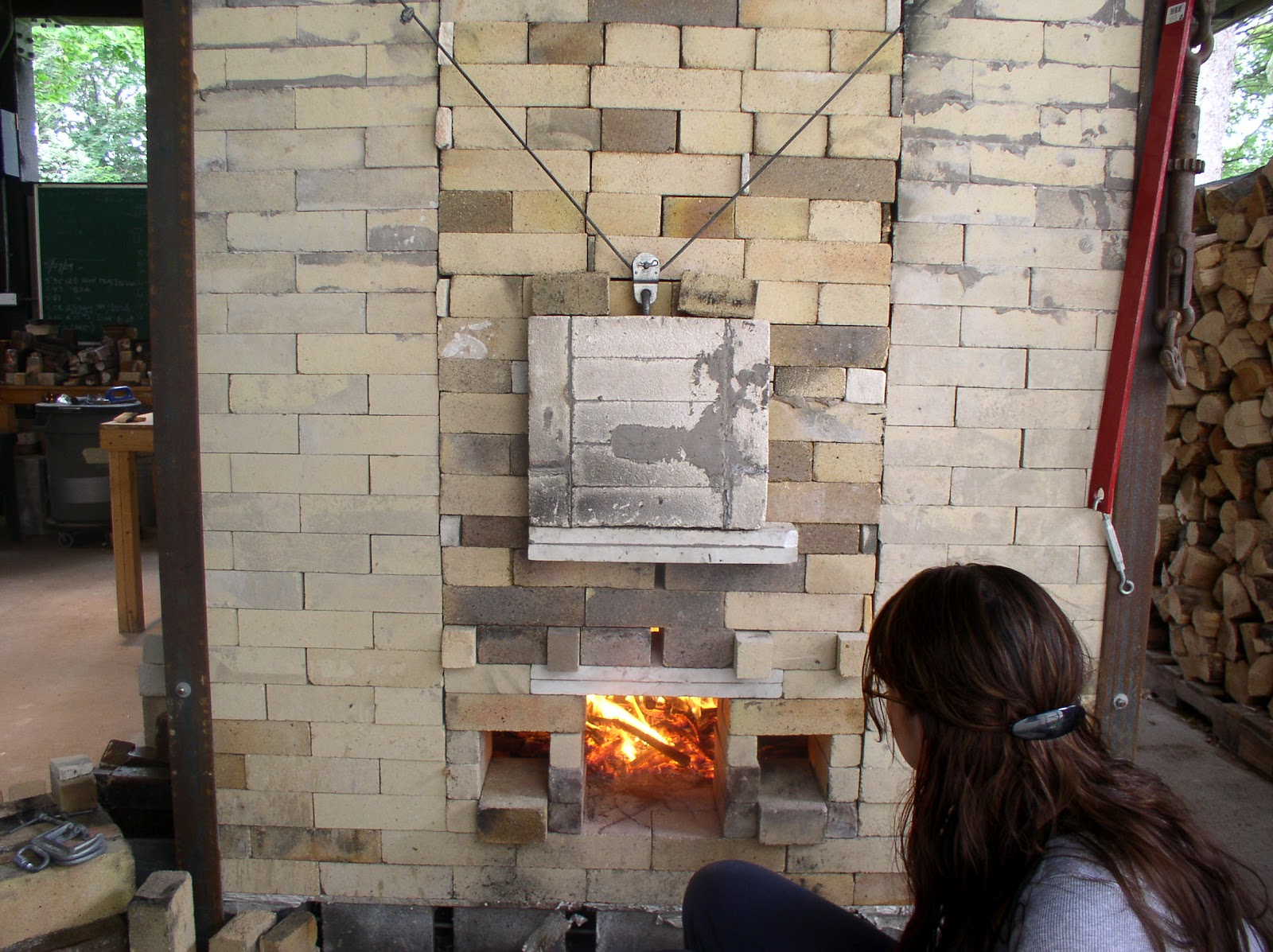
1) We changed the door configuration. All ports were brought up one course. We (I) thought this might help with keeping coals in the firebox while letting more primary air in over the coals. The secondary air ports were move up as was the stoking port. These changes proved to be a problem in hindsight. It created a jet stream through the chamber making damper management more difficult and heat distribution erratic. At least that is my thinking.
2) The ware load was not suited to the chamber. Too much flatware with not enough volumetric ware to baffle the flame.
So, to condense the schedule (Our pyrometer is in the rear of the chamber; the cones in the rear are 8,9,10, while in the front we use 8,9,10,11,12. We have easily reached ∆ 12 in the front in past firings.)-
Start up: 6:30 pm (Thursday April 26)
Our intent was to go up very slow. We had a piece in the front that was tall and did not want to risk it. 10 to 15 degrees every half hour. We (Amber and Eric) stoked lightly through the night to hit our morning temperature goal of 500˚ F.
From that point we kept the ramp the same, keeping the damper 3/4 open for the duration. By midnight Saturday (April 27) we were at 1500˚ F.
My take on a long firing is simple- get it up to temperature and then soak for as long as personal energy and fuel allow. Here we took too much time at the front end to protect the ware. It is in some ways a waste of fuel. But the up side is that my sophomores got some experience in careful, attentive stoking, a process they will surely remember for future firings.
We hit 2000˚ at 10:30 am on Saturday. Our ramp was fairly consistent for the rest of the firing.
At 4:00 pm Saturday we had ∆ 8 soft in the rear and ∆ 10 down in the front. Then came the big stall. No matter what we could not push heat to the rear. We had the usual positive cues such as good heat in the firebox as indicated by lots of blue flame off the coals and white heat just above the coals, but we began to notice the flame as flat and streaking through the chamber. Also, we noticed a lot of unburned fuel or carbon at the crown of the firebox and into the upper ware chamber.
 |
| Previous door setup. |
I think the problem was the raised door ports. We were getting less chamber time from the flame, a jet stream in a sense, with the unburned fuel causing the stall. We had created zones in the firing chamber. I can't be sure, but when trying to dampen the kiln, we could not get the right fuel to air ratio, or I should say, get the flame to work around the chamber, not through it. Lots of smoke under the shed, but little to show for it in the kiln.
 |
| Door and stoking port block. |
As I said before, I have made some changes to the kiln floor and stacking scheme. I will certainly go back to the door pattern we used earlier. The changes and strategy will be discussed next post.

 |
| Wood fired by Bryan McGrath |
Tuesday, May 22, 2012
Anagama 2012
 |
| Old kiln yard MWPAI |
 |
| New kiln yard PrattMWP |
As a result of the firing, I made some changes to the kiln floor and the stacking scheme for the next firing. My reasoning will be laid out as well.
I just read a piece from the NCECA conference, a panel discussion on soda firing. I am amazed at the differing approaches and technical knowledge sited for various results. Any technical information stated is always helpful. No matter how experienced a potter it is always good to hear this information from others to compare and contrast notions. It would take far too many lifetimes to acquire true expertise alone. Ceramics is too broad and deep a medium.
But the information can sometimes, at quick glance, seem contradictory. The reason lies in the many, many variables found in each technique or process; variables that are too often, for brevity, left out, something of which we all need to be mindful.
Any technique passed on to another is just show and tell, regardless of who is showing and telling. All techniques need to be understood intrinsically, and as a result, applicable under various conditions. One needs to understand process in a broad manner. Firing a kiln is the best example. Simple put, all techniques need to become yours, no matter how traditional or modern they appear. This takes time and attention. In the end, the technique will become yours for your needs and materials. That is the goal.
Subscribe to:
Posts (Atom)
