Monday, November 18, 2013
Val Cushing
It is with great sadness that we have learned of the passing of Val Cushing. I was fortunate, as so many others, to have met him and hosted him for a workshop here some years ago. I was lucky to be a second generation student, that is, I was taught by one of Val's students, John Jessiman. Cushing's influence can not be overstated nor his generosity in freely sharing his knowledge and experience.

Monday, November 11, 2013
Brooklyn Clay Student's Rock and Roll Weekend
From 4:00 p.m. Friday afternoon till 12 noon today- whew!
We jammed as much as possible into our weekend workshop- a glaze and load Friday night marathon; Saturday's firings of the downdraft and the salt kilns; viewing our collection of turn of the century White's Pottery salt crocks and ware in Fountain Elms; cozy studio tour and demonstration; Veronica's mold making workshop and studio tour; salting the kiln (a better cloud); Gerber's Pub; trip to the Everson in Syracuse and Sculpture Space in Utica; Symeon's for dinner and of course the kiln opening this morning.
My sincere thanks to the Brooklyn students for your patience, interest and great enthusiasm. It was a pleasure and privilege to work with you guys. DOG!
Also great thanks to Cammi and Michael and Keith for organizing the trip and the workload. It is great to work with people who know their stuff.
You wore me out, so now on to a relaxing massage, drinking good wine (thanks for that and the card) and then on to the work week.
What a kick! Thanks again...
Bryan
We jammed as much as possible into our weekend workshop- a glaze and load Friday night marathon; Saturday's firings of the downdraft and the salt kilns; viewing our collection of turn of the century White's Pottery salt crocks and ware in Fountain Elms; cozy studio tour and demonstration; Veronica's mold making workshop and studio tour; salting the kiln (a better cloud); Gerber's Pub; trip to the Everson in Syracuse and Sculpture Space in Utica; Symeon's for dinner and of course the kiln opening this morning.
My sincere thanks to the Brooklyn students for your patience, interest and great enthusiasm. It was a pleasure and privilege to work with you guys. DOG!
Also great thanks to Cammi and Michael and Keith for organizing the trip and the workload. It is great to work with people who know their stuff.
You wore me out, so now on to a relaxing massage, drinking good wine (thanks for that and the card) and then on to the work week.
What a kick! Thanks again...
Bryan
Saturday, September 14, 2013
New Year Horse Race
It took a few years, but we are re-energized. The coming year looks to be a good one.
We are very happy to welcome ceramic artist Veronica Byun to our department as Artist in Residence. She brings a wealth of experience and knowledge in ceramic sculpture. Originally from Seoul, Korea, Veronica is currently based in New Jersey. Her education includes degrees from Alfred, RISD and post Baccalaureate work at Syracuse University.
She has exhibited in numerous national and international exhibitions including the "54th Premio Faenza International Ceramic Art Competition," in Italy, the Taiwan Ceramics Biennale 2008, in Taipei, Taiwan and "World Women: On the Horizon," at the Baltimore Clayworks, in Maryland. She is represented by Loveed Gallery, in New York City.
Awards include residencies at Guldagergard Ceramic Research Center, Denmark, PrattMWP, and a New Jersey State Council on the Arts Fellowship. Her work has been reviewed in numerous publications including Ceramics Monthly, Ceramics Art and Perception and The Philadelpia Enquirer.
This fall Veronica is teaching a ceramic sculpture course in our continuing education division and will be conducting a mold making workshop in November (more to come on that).
We welcome Veronica and are excited to be working with her. We will be posting images of her work in the near future. In the meantime you may go to the link below...
www.veronicabyun.com
We are very happy to welcome ceramic artist Veronica Byun to our department as Artist in Residence. She brings a wealth of experience and knowledge in ceramic sculpture. Originally from Seoul, Korea, Veronica is currently based in New Jersey. Her education includes degrees from Alfred, RISD and post Baccalaureate work at Syracuse University.
She has exhibited in numerous national and international exhibitions including the "54th Premio Faenza International Ceramic Art Competition," in Italy, the Taiwan Ceramics Biennale 2008, in Taipei, Taiwan and "World Women: On the Horizon," at the Baltimore Clayworks, in Maryland. She is represented by Loveed Gallery, in New York City.
Awards include residencies at Guldagergard Ceramic Research Center, Denmark, PrattMWP, and a New Jersey State Council on the Arts Fellowship. Her work has been reviewed in numerous publications including Ceramics Monthly, Ceramics Art and Perception and The Philadelpia Enquirer.
This fall Veronica is teaching a ceramic sculpture course in our continuing education division and will be conducting a mold making workshop in November (more to come on that).
We welcome Veronica and are excited to be working with her. We will be posting images of her work in the near future. In the meantime you may go to the link below...
www.veronicabyun.com
Tuesday, April 16, 2013
The itinerary for the June workshop will be-
Friday AM- Demonstration of throwing a vase for surface decoration; discussion of engobes for use in salt. Slides in the evening.
Friday Afternoon- Demo of bottles and other forms with the use of applique, stamping and color for salt.
Saturday- Demonstration of larger forms for firing in salt. Ideas for experimentation; Slides of my work in the evening.
Sunday- Workday
Following Friday- glaze and load kiln.
Saturday- Fire kiln with salting party in the evening.
Sunday Evening- Kiln opening and critique.
Exact times for the above will be provided to students once course is assured of running.
Friday AM- Demonstration of throwing a vase for surface decoration; discussion of engobes for use in salt. Slides in the evening.
Friday Afternoon- Demo of bottles and other forms with the use of applique, stamping and color for salt.
Saturday- Demonstration of larger forms for firing in salt. Ideas for experimentation; Slides of my work in the evening.
Sunday- Workday
Following Friday- glaze and load kiln.
Saturday- Fire kiln with salting party in the evening.
Sunday Evening- Kiln opening and critique.
Exact times for the above will be provided to students once course is assured of running.
Saturday, March 2, 2013
Spring Firings- Salt Is In The Air

 |
| Salt Vapor Shrouds the Campus Photo by Nancy L. Ford |
We are again offering a June Workshop. We will be exploring the use of color and surface fired in a salt kiln. More information and the itinerary for the workshop will be posted in April. For now, stay warm! I am kicking around the idea of including a second firing of some work for the surface effects as seen in the piece below.
 |
| Salt Fired Bowl- refired at ∆10 Reduction for Carbon Luster |
Friday, February 15, 2013
Brooklyn Fire
We just received news of the devastating fire last night on the Pratt Brooklyn campus. We don't know exactly what this means for those students who lost work or for that matter how long it will take for the campus to recover. We on the upstate campus are ready to help in any way...
Friday, July 27, 2012
Vapor
 |
| the Altar |
Wednesday, May 23, 2012
What we did
 |
| The PrattMWP anagama |
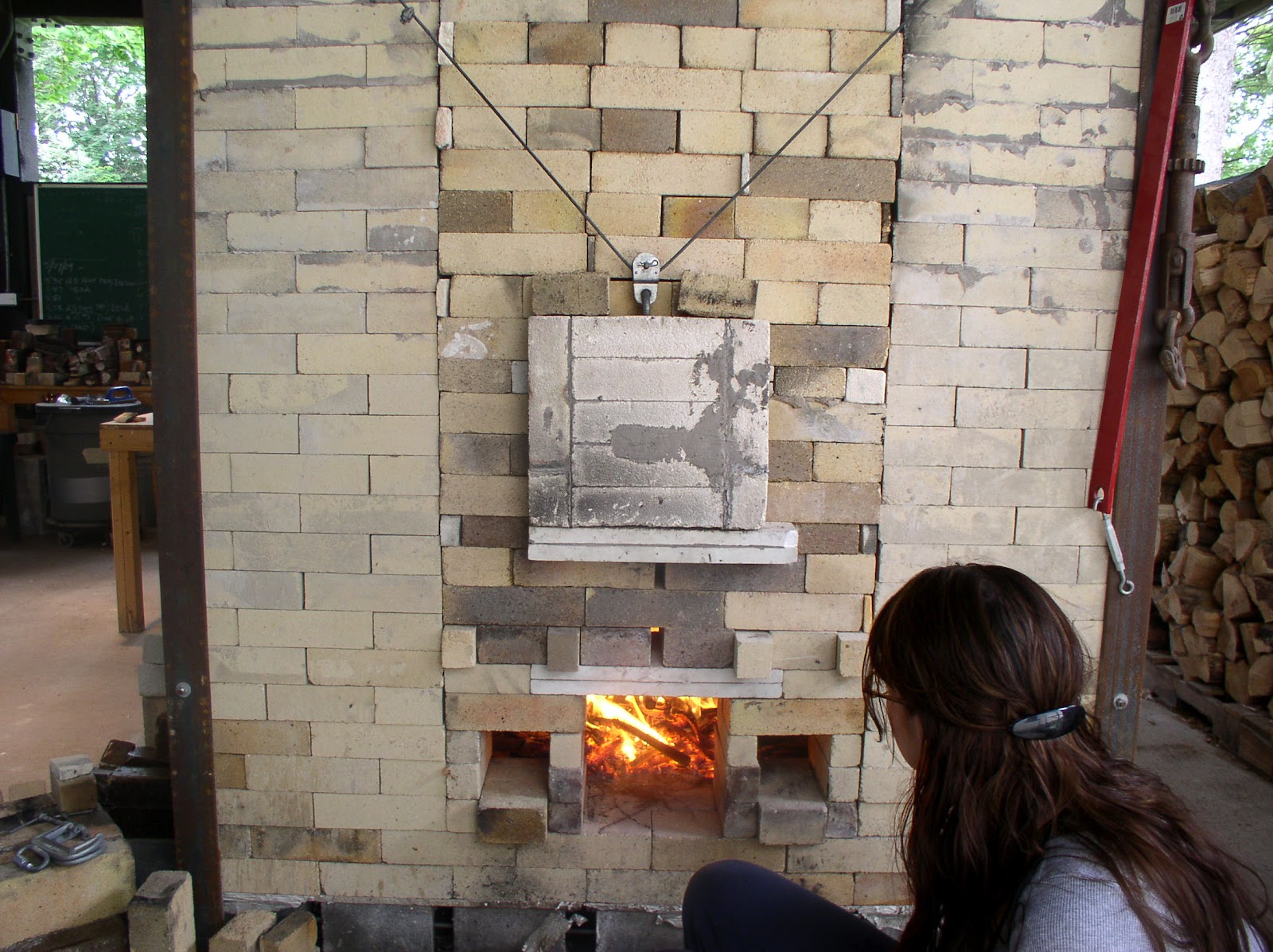
1) We changed the door configuration. All ports were brought up one course. We (I) thought this might help with keeping coals in the firebox while letting more primary air in over the coals. The secondary air ports were move up as was the stoking port. These changes proved to be a problem in hindsight. It created a jet stream through the chamber making damper management more difficult and heat distribution erratic. At least that is my thinking.
2) The ware load was not suited to the chamber. Too much flatware with not enough volumetric ware to baffle the flame.
So, to condense the schedule (Our pyrometer is in the rear of the chamber; the cones in the rear are 8,9,10, while in the front we use 8,9,10,11,12. We have easily reached ∆ 12 in the front in past firings.)-
Start up: 6:30 pm (Thursday April 26)
Our intent was to go up very slow. We had a piece in the front that was tall and did not want to risk it. 10 to 15 degrees every half hour. We (Amber and Eric) stoked lightly through the night to hit our morning temperature goal of 500˚ F.
From that point we kept the ramp the same, keeping the damper 3/4 open for the duration. By midnight Saturday (April 27) we were at 1500˚ F.
My take on a long firing is simple- get it up to temperature and then soak for as long as personal energy and fuel allow. Here we took too much time at the front end to protect the ware. It is in some ways a waste of fuel. But the up side is that my sophomores got some experience in careful, attentive stoking, a process they will surely remember for future firings.
We hit 2000˚ at 10:30 am on Saturday. Our ramp was fairly consistent for the rest of the firing.
At 4:00 pm Saturday we had ∆ 8 soft in the rear and ∆ 10 down in the front. Then came the big stall. No matter what we could not push heat to the rear. We had the usual positive cues such as good heat in the firebox as indicated by lots of blue flame off the coals and white heat just above the coals, but we began to notice the flame as flat and streaking through the chamber. Also, we noticed a lot of unburned fuel or carbon at the crown of the firebox and into the upper ware chamber.
 |
| Previous door setup. |
I think the problem was the raised door ports. We were getting less chamber time from the flame, a jet stream in a sense, with the unburned fuel causing the stall. We had created zones in the firing chamber. I can't be sure, but when trying to dampen the kiln, we could not get the right fuel to air ratio, or I should say, get the flame to work around the chamber, not through it. Lots of smoke under the shed, but little to show for it in the kiln.
 |
| Door and stoking port block. |
As I said before, I have made some changes to the kiln floor and stacking scheme. I will certainly go back to the door pattern we used earlier. The changes and strategy will be discussed next post.

 |
| Wood fired by Bryan McGrath |
Tuesday, May 22, 2012
Anagama 2012
 |
| Old kiln yard MWPAI |
 |
| New kiln yard PrattMWP |
As a result of the firing, I made some changes to the kiln floor and the stacking scheme for the next firing. My reasoning will be laid out as well.
I just read a piece from the NCECA conference, a panel discussion on soda firing. I am amazed at the differing approaches and technical knowledge sited for various results. Any technical information stated is always helpful. No matter how experienced a potter it is always good to hear this information from others to compare and contrast notions. It would take far too many lifetimes to acquire true expertise alone. Ceramics is too broad and deep a medium.
But the information can sometimes, at quick glance, seem contradictory. The reason lies in the many, many variables found in each technique or process; variables that are too often, for brevity, left out, something of which we all need to be mindful.
Any technique passed on to another is just show and tell, regardless of who is showing and telling. All techniques need to be understood intrinsically, and as a result, applicable under various conditions. One needs to understand process in a broad manner. Firing a kiln is the best example. Simple put, all techniques need to become yours, no matter how traditional or modern they appear. This takes time and attention. In the end, the technique will become yours for your needs and materials. That is the goal.
Saturday, March 24, 2012
Spring 2012 Anagama Firing
 |
| Soy bottle and tray; wood fired by Bryan McGrath |
Our anagama is one of only four operating wood burning kilns in central New York State. There may be a total of 12 in the entire state, so we are in exclusive company. Our design is unique for its hidden chamber between the main chamber and the stack. We are planning to experiment with a mid temperature clay in that chamber with the possible addition of some salt.
 |
| No, this image isn't from this winter! |
If you are in the area the best day to stop by is the evening of April 21st as we fire the kiln off. Quite a site!
Monday, September 5, 2011
Fall 2011
For those new to this post and especially those just starting to throw (my sophomores and Cont. Ed. students, I would suggest you go to the earlier posts on centering, and throwing a cylinder. I will be posting some videos this semester as we get them produced. Looking forward to the year.
You might want to visit the Everson Museum in Syracuse very soon to see the David MacDonald exhibition. It comes down mid September. Seeing his pottery is worth the trip! While you are there go downstairs to view the permanent ceramic collection.
The once preeminent museum for American ceramics, I hope the recent clay exhibits (Ah Leon's "School Room" last spring and now David's) portend a return to the Everson's focus and support of the ceramic arts.
You might want to visit the Everson Museum in Syracuse very soon to see the David MacDonald exhibition. It comes down mid September. Seeing his pottery is worth the trip! While you are there go downstairs to view the permanent ceramic collection.
The once preeminent museum for American ceramics, I hope the recent clay exhibits (Ah Leon's "School Room" last spring and now David's) portend a return to the Everson's focus and support of the ceramic arts.
Thursday, August 4, 2011
Rethinking the future
We will be looking at our offerings and possible workshop topics for the new year. Stay tuned...
Saturday, May 21, 2011
Turn, Turn, Turn
Most of us have a keen sense of the "present" and it's surroundings. We are programmed or taught to respond to the needs of the moment. In the present, we make adjustments in order to reach some predetermined goal or recall some unpleasant experience to avoid impending disaster.
We (anointed "leaders" excluded herein- their blinders a spoil of rank, so it seems) are also innately geared to grow stuff, the default setting for survival. The present in its full context (modern physics aside here, please) is a bridge from the past to the future. Without this sufficient (but not always necessary) structure for reasoning we are on a treadmill, not a path, with history too often repeated, progress stifled, and a pace toward entropy ramped.
We also have the mental tools to soften the rough edges of history, to help maintain our heading toward the future and progress. We acknowledge that growth and decline is the essence of life. It also gives it value and meaning.
Every season, every idea, every mark is infused with and defined by ineluctable movement. In some cases that movement, if drawn as a line, may well follow a "straight" course, a beginning to an end. Or it may return to meet itself in the gentlest way realizing the archetypical circle, the best of possibilities. Unfortunately, in the long run, the latter is hostage to the former.
The notion of a team- a complimentary, non-hierarchical concept is the most efficient, healthy path to growth. A team, however, is the most difficult model to "manage" as each member must choose a time to lead, a time to follow, a time to teach, a time to learn. It requires that the whole be greater than the parts, with each part remaining essential to the whole. It has many leaders, not one.
In our given time, we can at best hope to describe and move in a line that returns to itself, creating a shape that is a whole; a space that has a center. And though the edges of that shape may not always be fair, the space within is forever defined.
 |
| the circle |
Every season, every idea, every mark is infused with and defined by ineluctable movement. In some cases that movement, if drawn as a line, may well follow a "straight" course, a beginning to an end. Or it may return to meet itself in the gentlest way realizing the archetypical circle, the best of possibilities. Unfortunately, in the long run, the latter is hostage to the former.
The notion of a team- a complimentary, non-hierarchical concept is the most efficient, healthy path to growth. A team, however, is the most difficult model to "manage" as each member must choose a time to lead, a time to follow, a time to teach, a time to learn. It requires that the whole be greater than the parts, with each part remaining essential to the whole. It has many leaders, not one.
In our given time, we can at best hope to describe and move in a line that returns to itself, creating a shape that is a whole; a space that has a center. And though the edges of that shape may not always be fair, the space within is forever defined.
Friday, April 29, 2011
anagama update
9:47 pm- things are going smoothly. Nearing 1500˚ F in the back. Pizza and wings just arrived. Very hungry after the long day and a trip to the gym. We have split most of the "new" wood to smaller sticks. The midnight shift will have some markers to make; it is a good crew, so I am not worried...
Follow up:
We finished the firing around 6:00 pm the following evening. Actually, we fired it off twice. We reached ∆ 9 in the back of the chamber around 1:00 pm Saturday. Since the school was having a reception for new students, we kept a light stoking pattern to "show off" the firing, but lost considerable heat in the process. At 3:00 pm we decided to go for it again. With steady work and damper adjustments, we were able to regain the lost heat to bring the firing to an end. We completed the evening by firing off the salt kiln.
Then to the beer, chips and laughs "around the camp fire." A great week and a great finish to a harried, sometimes very frustrating semester, and a physically and mentally exhausting year.
It has been a great run...
Follow up:
We finished the firing around 6:00 pm the following evening. Actually, we fired it off twice. We reached ∆ 9 in the back of the chamber around 1:00 pm Saturday. Since the school was having a reception for new students, we kept a light stoking pattern to "show off" the firing, but lost considerable heat in the process. At 3:00 pm we decided to go for it again. With steady work and damper adjustments, we were able to regain the lost heat to bring the firing to an end. We completed the evening by firing off the salt kiln.
Then to the beer, chips and laughs "around the camp fire." A great week and a great finish to a harried, sometimes very frustrating semester, and a physically and mentally exhausting year.
It has been a great run...
Firing the Anagama
After a long winter's wait, we have finally loaded the wood kiln. We started the firing this am at 6:00 am. Vincent was the man. The word is that he couldn't find matches so he carried a flaming piece of wood through the studio that he ignited from one of the burners on the car kiln. We decided this Olympic style run to ignition was something only Vincent could pull off. Wish we had video.
It is 1:30 pm and we are at about 950˚ F in the rear of the chamber. Will keep posting and set up some images.
It is 1:30 pm and we are at about 950˚ F in the rear of the chamber. Will keep posting and set up some images.
Saturday, December 18, 2010
End of Semester
Grades are in. This has been a very busy semester in so many ways. Though I risk with this post sounding like one of those xeroxed Christmas card/letters we all love (so much) to get, there are a few things we want to convey to all who follow us.

 We officially opened and dedicated the Vincent R. Clemente Ceramic Resource Room in October. It is a significant addition to the department. We are grateful and indebted to Vincent and Mary for their generosity to the ceramics department here at MWP. The packed house event was a highlight of the semester. Special thanks to all who helped pull the very comfortable and information packed room together.
One important person, however, was not with us. We lost Mary this year after a stoic yet considerable effort to regain her health. Her outlook and a never ending positive attitude taught us something about facing the inevitable in life with dignity and courage, not to mention a sense of humor to the very end. She is missed. Vincent continues to be an important part of our department giving demonstrations and helping with salt and wood firings (not to mention the jibes and funny stories).
The recruiting trail was especially satisfying and pleasantly tiring. Trips to the Cape, Poughkeepsie, and Toronto were on the docket. I enjoyed meeting all who were interested in attending PrattMWP. Some excellent work and, as always, very interesting students prove to me that the arts will continue to thrive. We hope you begin your training here!
Each host city for the reviews was memorable for the local art scene. The Cape Cod Museum in Dennis is gem. Can't wait to go back. The Mill Street Loft in Poughkeepsie provides an incredible art experience for local high school students with an obviously dedicated (and in my case, caring- thanks again, Gabrielle) staff. I am a new fan. Finally, Toronto is an experience like no other. The AGO, ROM, and the Gardiner make this world class city a must visit on a regular basis. We missed the Terra Cotta Warriors at the ROM but hope to make a trip to Montreal in February for the exhibition.
Janelle was honored with a teaching award from a local civic group for her work with the visually impaired. She also put in a strenuous but very successful semester mounting three alumni shows in the school of art gallery.
The continuing education students are making outstanding work. In response, we are planning an exciting addition to the ceramics department this spring- the "Hallway Gallery" will open in February. Upstairs in the ceramics building, next to the Clemente Resource Room, the gallery will provide much needed local exhibition space for ceramic works by the students of MWPAI and PrattMWP. We plan to have 4 or 5 group shows a year with the remainder of the time exhibiting the permanent collection of work from the sophomore classes. We will keep you posted on openings and events.
Throwing Day for Empty Bowls is in February with the event planned for early April. This year we will be staging the event on campus. We will also be reaching out to a larger number of organizations who provide help to those in need. We are very excited about the changes.
The fall anagama firing was postponed (too busy to fire the wood kiln- what is that???) and will be fired this spring. The wood is in and the weather will determine the dates. The continuing education students have loaded a salt and will be firing this Monday. The semester never ends!!!
It has been a kick of a semester- good creac, as they say in Ireland. Lots of laughs, some difficult times for some in the "family" but lots of good pots being made. Let's do it again. Form is king and power to the people!


One important person, however, was not with us. We lost Mary this year after a stoic yet considerable effort to regain her health. Her outlook and a never ending positive attitude taught us something about facing the inevitable in life with dignity and courage, not to mention a sense of humor to the very end. She is missed. Vincent continues to be an important part of our department giving demonstrations and helping with salt and wood firings (not to mention the jibes and funny stories).
The recruiting trail was especially satisfying and pleasantly tiring. Trips to the Cape, Poughkeepsie, and Toronto were on the docket. I enjoyed meeting all who were interested in attending PrattMWP. Some excellent work and, as always, very interesting students prove to me that the arts will continue to thrive. We hope you begin your training here!
 |
| William Daley |
Each host city for the reviews was memorable for the local art scene. The Cape Cod Museum in Dennis is gem. Can't wait to go back. The Mill Street Loft in Poughkeepsie provides an incredible art experience for local high school students with an obviously dedicated (and in my case, caring- thanks again, Gabrielle) staff. I am a new fan. Finally, Toronto is an experience like no other. The AGO, ROM, and the Gardiner make this world class city a must visit on a regular basis. We missed the Terra Cotta Warriors at the ROM but hope to make a trip to Montreal in February for the exhibition.
Janelle was honored with a teaching award from a local civic group for her work with the visually impaired. She also put in a strenuous but very successful semester mounting three alumni shows in the school of art gallery.
The continuing education students are making outstanding work. In response, we are planning an exciting addition to the ceramics department this spring- the "Hallway Gallery" will open in February. Upstairs in the ceramics building, next to the Clemente Resource Room, the gallery will provide much needed local exhibition space for ceramic works by the students of MWPAI and PrattMWP. We plan to have 4 or 5 group shows a year with the remainder of the time exhibiting the permanent collection of work from the sophomore classes. We will keep you posted on openings and events.
Throwing Day for Empty Bowls is in February with the event planned for early April. This year we will be staging the event on campus. We will also be reaching out to a larger number of organizations who provide help to those in need. We are very excited about the changes.
 |
| Porcelain, Philadelphia NCECA |
 |
| Taylor Edwards, Sophomore, Ceramic Sculpture Class, 2010 |
Friday, September 24, 2010
Throwing 101- Centering


Start with a well wedged ball of clay that fits in your hand as seen (we will explain the advantages of spiral wedging later). The smallest ball would be with the fingers overlapped as shown here. The largest would be as shown above. This will fit your hand. We do not worry about how much clay you are using. Weights are not important, volume is. Matching the ball of clay to your hand and body is very important.
We will break down the process of throwing into three distinct phases:
- Centering
- Opening
- Pulling the Walls
Each phase will have two hand positions. In effect, you need only learn six hand positions, that's all- six. You can quicken the process with a bit of memorization- the six hand positions. We will clearly demonstrate them. Remember the previous post on body positioning. Then, slap the ball down on the wheel head or batt as close to the center as possible. Seal the base of the ball with the heal of the hands. Generously lubricate the clay.

Centering- It's the most important aspect in learning to throw. You can not make a pot of good design or proportion without first centering the mass of clay on the wheel. Some potters work "in the ball park" so to speak, but at some point the pot must be brought to a relatively symmetrical aspect on an axial orientation.
-First hand position: "Wrap/Rotate/Squeeze"
 |
| hands overlapped |
 |
| wrap, rotate, squeeze |
 |
| relax in place, then release- don't spring away from contact |
-Second hand position: "Cup/Karate Chop" or "centering position"
 |
| left arm should be line up directly from hip to wrist through center of cone |
 |
| push down with right, push in with left |
 |
| center the "mushroom" |
 |
| 3 to 1 proportions (width to height) |
You are almost there.
Keeping the hands in centering position, push the clay in (with left hand) at the base and let the clay rise up a bit, then push it back down to the centered proportion as shown and stated. This assures that the entire piece of clay is centered, that is, the base or "skirt" (shown) is centered as well. The skirt should be a smooth curved transition to the batt, the result of the left hand heal contact when hands are in the centering position. Repeat this "up and down" until the clay is (re)centered (3 to 1 proportions) and the skirt is set- the skirt is the first contact point for pulling the walls. Everything you do now sets up what you are going to do later!!!
 |
| skirt |
 |
| up |
 |
| down |
 |
| centered! |
Wednesday, September 8, 2010
Throwing 101
Before getting down to the mechanics of throwing, we need to make a few important points.
Making pottery is a skill, a craft. Like learning to play an instrument, it take many hours of practice and patience. And more practice. Here at PrattMWP, with both college and continuing learners, practice time will vary greatly as one group of students is taking the class for credit, the other is more recreational. In either case, quality practice or "wheel time" is important.
Everyone learns at a different pace. Just keep practicing. A note book is absolutely necessary. There is too much information to absorb at once. The note book is your reference when the instructor is not nearby. We will break the process down into a clear, concise set of hand positions. Some simple memorization will help immensely.
Finally, have fun. There are many challenges but there is always something new to learn. What better way to spent your time!
Over the next few post we will demonstrate the craft of throwing of a standard cylinder. To start, we need to explain some important concepts-
1. You throw with your entire body. Your hands are the most obvious part of the mechanics of throwing, but- You throw from the hips and with your legs.
Your hips are your base. They don't move while you work. Place your bottom on the stool or seat away from the wheel so when bending forward your nose is over the center of the wheel.
Your legs are a source of strength. Place you right leg on the pedal (best for throwing with the wheel turning counter clockwise) or stirrups so the knee is slightly above the splash pan. Use a brick or two to prop up the left leg so it is the same height as the leg on the pedal. Like Susan Sommers' "thigh master" commercial of years ago, squeeze the splash plan. This will get your legs involved, making a strong connection to the hips. As you bend over the wheel, place your elbows on your thighs as close to the hips as comfortable. This is the best position for throwing. It is not great for the back, true. We will talk about that in another post.
So- hips, legs, and hands. Keep you elbows on your legs close to the hips and your nose down. Finally, relax the shoulders! You should work from strength and technique, not tension.
2. Learn and develop a rhythm while throwing. I like to use a simple mantra to keep students on track: "Lubricate/work/relax and release- lubricate/work/relax and release." Say it over a few times and you get a nice sing-song lilt that sticks with you. This will slow you down and remind you of some important details that will make your effort easier and successful. We will talk more about this as we go on. Photos to follow...
Making pottery is a skill, a craft. Like learning to play an instrument, it take many hours of practice and patience. And more practice. Here at PrattMWP, with both college and continuing learners, practice time will vary greatly as one group of students is taking the class for credit, the other is more recreational. In either case, quality practice or "wheel time" is important.
Everyone learns at a different pace. Just keep practicing. A note book is absolutely necessary. There is too much information to absorb at once. The note book is your reference when the instructor is not nearby. We will break the process down into a clear, concise set of hand positions. Some simple memorization will help immensely.
Finally, have fun. There are many challenges but there is always something new to learn. What better way to spent your time!
Over the next few post we will demonstrate the craft of throwing of a standard cylinder. To start, we need to explain some important concepts-
1. You throw with your entire body. Your hands are the most obvious part of the mechanics of throwing, but- You throw from the hips and with your legs.
 |
| legs up, shoulders down, nose down |
 |
| elbows on legs, close to hips |
So- hips, legs, and hands. Keep you elbows on your legs close to the hips and your nose down. Finally, relax the shoulders! You should work from strength and technique, not tension.
2. Learn and develop a rhythm while throwing. I like to use a simple mantra to keep students on track: "Lubricate/work/relax and release- lubricate/work/relax and release." Say it over a few times and you get a nice sing-song lilt that sticks with you. This will slow you down and remind you of some important details that will make your effort easier and successful. We will talk more about this as we go on. Photos to follow...
Saturday, September 4, 2010
Making pots: first, a note on the politics of media...
Anyone new to throwing faces real challenges, an understatement to be sure. But a little appreciated aspect of pottery, or working with clay in general, is the initial and core relationship the ceramic artist or potter confronts with the material. Unlike most other three dimensional media, clay has no formal structure in the conventional sense. Potters and ceramic sculptors enjoy a greater array of possibilities, but also require much more than a cursory knowledge of our materials to produce a final work- let alone a good one.
All of the traditional and newer materials- metal, wood, plastics, rubber, stone, or found objects come with space filling and defining mass that holds itself together without and before external assistance (we'll skip "performance" work that sculptors somehow deemed themselves qualified to execute the last few decades- a curious conceit that requires a great deal of patience to talk about). When manipulating any of these materials, the maker starts with a structural surety that is then altered to the aesthetic need of the artist. With some exceptions the forming material itself is seldom "created." (Unless the artist is making his or her own steel from molten iron and coke! Indeed, I loved the Friday night "pours" of bronze or aluminum while in grad school at Syracuse University. And I remember spending more time in the glass blowing studio at Penland, one summer long ago, than in the clay shop! Glass blowers rock.)
I make this point to argue against the time honored and worn out hierarchy of artistic media (and with it, the art market) that dominates the art world. All three dimensional work requires a degree of skill (most often by the artist- this is another issue for a later time) to manipulate the material into some form and shape, or arrangement, true enough. But, clay simply exists in a form of mass only, with no clear direction or dimension. How is it that this trait leads to its lowly place, residing in the lower tiers of relevance and respect in the western art world (US)? Relatively few galleries can be found with clay artists an important part of the stable. It is not precious, being found literally everywhere, and the process is little understood by those looking at it. It is not pristine, thank god. It is only the stuff of life- in reality, not just as metaphor. So it is the most common of materials, yet requires the most uncommon mastery to achieve truly timeless results. Such is life.
Making works from clay requires the simultaneous creation of structure, form and shape, and surface, especially making pots, to which you may add the acquired knowledge of functional design. As mentioned above, some media, techniques in metalsmithing come to mind, perform the same magic. Luckily, the jeweler, being in the much more marketable realm of fashion, enjoys greater popularity, a reflection of our cultural leanings. Clay works are certainly enjoying a popularity like never before. But, unlike a culture educated in and by the crafts in general, like Japan, handmade pots in our culture are not universally received into the home. This seems the case regardless of the very successful move toward fashion seen in much contemporary (American baroque?) work. Surface design manipulation is stronger than ever. But I think William Morris would be rolling in his grave.
A word of caution is needed. Fashion is just that. I like the ornamentation and decoration (confession: I wish I was better at it). Even in Japan highly decorated works easily coexist with the understated, thanks mainly to the local geopolitical dominance Japan once enjoyed. In our culture (and others to be fair), fashion (and sparkle) generally trumps utility and/or "risk taking," the core exercise of mentally reworking visual equations, that was drilled into our heads in art school. And, too often, sadly, fashion trumps art (to rework a favorite phrase from a colleague). As long as we understand the difference, all is forgiven. Commerce is a tough ruler, though.
It is naive to think the hierarchy will ever change. And, as mentioned above, there are certainly other factors in play. And many of my points can be added to or challenged (happily received!) But it is useful to know that our craft is indeed special. Much like the writer and the musician, we make something from nothing. Quite the feat!
A note is needed on media of another sort- the internet. As I have said many times in class, beware of what you see on the internet. "You Tube" is great but it seems anyone with an introductory course (or two?) under their belt thinks they have something to teach. This is endearing but many new potters should wait awhile before getting into the sharing mode. So many tired old wives tales are past along with no critical reflection. Teaching is an art form in itself and nothing makes the teacher better than experience, offline please.
Finally, magazines are a very good source of images and information. Here, too, a little discretion is helpful. As I learned early in my career, color (blue) sells. Editors want to sell magazines. Sometimes the visual flash of an image masks the quality (or lack therein) of the work. Anyone can now take quality images of their work and submit them for publication. But the work should be more than eye candy and slide craft.
I like the current movement to bring critical review to ceramics, but worry that it will just descend into the same lame push toward the "new" and the different which has resulted in so much bad work being done in the name of "Art." Just more politics with the reviewers holding sway.
So as you begin, note that nothing takes the place of an experienced teacher- still. Find teachers you trust. They will know what artists are worth looking at. Taking classes at an art school, my students come to know that we are teaching more than the mechanics of throwing. We want to meld craftsmanship with design, broad and deep bodies of knowledge, rich in history, loaded with excellent references to give you and your work context. Is it "art?" Time will tell. It is the process and the connections that are important. For now the goal is learning to throw. Then comes the important part- making pots. Enjoy the experience...
All of the traditional and newer materials- metal, wood, plastics, rubber, stone, or found objects come with space filling and defining mass that holds itself together without and before external assistance (we'll skip "performance" work that sculptors somehow deemed themselves qualified to execute the last few decades- a curious conceit that requires a great deal of patience to talk about). When manipulating any of these materials, the maker starts with a structural surety that is then altered to the aesthetic need of the artist. With some exceptions the forming material itself is seldom "created." (Unless the artist is making his or her own steel from molten iron and coke! Indeed, I loved the Friday night "pours" of bronze or aluminum while in grad school at Syracuse University. And I remember spending more time in the glass blowing studio at Penland, one summer long ago, than in the clay shop! Glass blowers rock.)
I make this point to argue against the time honored and worn out hierarchy of artistic media (and with it, the art market) that dominates the art world. All three dimensional work requires a degree of skill (most often by the artist- this is another issue for a later time) to manipulate the material into some form and shape, or arrangement, true enough. But, clay simply exists in a form of mass only, with no clear direction or dimension. How is it that this trait leads to its lowly place, residing in the lower tiers of relevance and respect in the western art world (US)? Relatively few galleries can be found with clay artists an important part of the stable. It is not precious, being found literally everywhere, and the process is little understood by those looking at it. It is not pristine, thank god. It is only the stuff of life- in reality, not just as metaphor. So it is the most common of materials, yet requires the most uncommon mastery to achieve truly timeless results. Such is life.
Making works from clay requires the simultaneous creation of structure, form and shape, and surface, especially making pots, to which you may add the acquired knowledge of functional design. As mentioned above, some media, techniques in metalsmithing come to mind, perform the same magic. Luckily, the jeweler, being in the much more marketable realm of fashion, enjoys greater popularity, a reflection of our cultural leanings. Clay works are certainly enjoying a popularity like never before. But, unlike a culture educated in and by the crafts in general, like Japan, handmade pots in our culture are not universally received into the home. This seems the case regardless of the very successful move toward fashion seen in much contemporary (American baroque?) work. Surface design manipulation is stronger than ever. But I think William Morris would be rolling in his grave.
A word of caution is needed. Fashion is just that. I like the ornamentation and decoration (confession: I wish I was better at it). Even in Japan highly decorated works easily coexist with the understated, thanks mainly to the local geopolitical dominance Japan once enjoyed. In our culture (and others to be fair), fashion (and sparkle) generally trumps utility and/or "risk taking," the core exercise of mentally reworking visual equations, that was drilled into our heads in art school. And, too often, sadly, fashion trumps art (to rework a favorite phrase from a colleague). As long as we understand the difference, all is forgiven. Commerce is a tough ruler, though.
It is naive to think the hierarchy will ever change. And, as mentioned above, there are certainly other factors in play. And many of my points can be added to or challenged (happily received!) But it is useful to know that our craft is indeed special. Much like the writer and the musician, we make something from nothing. Quite the feat!
A note is needed on media of another sort- the internet. As I have said many times in class, beware of what you see on the internet. "You Tube" is great but it seems anyone with an introductory course (or two?) under their belt thinks they have something to teach. This is endearing but many new potters should wait awhile before getting into the sharing mode. So many tired old wives tales are past along with no critical reflection. Teaching is an art form in itself and nothing makes the teacher better than experience, offline please.
Finally, magazines are a very good source of images and information. Here, too, a little discretion is helpful. As I learned early in my career, color (blue) sells. Editors want to sell magazines. Sometimes the visual flash of an image masks the quality (or lack therein) of the work. Anyone can now take quality images of their work and submit them for publication. But the work should be more than eye candy and slide craft.
I like the current movement to bring critical review to ceramics, but worry that it will just descend into the same lame push toward the "new" and the different which has resulted in so much bad work being done in the name of "Art." Just more politics with the reviewers holding sway.
So as you begin, note that nothing takes the place of an experienced teacher- still. Find teachers you trust. They will know what artists are worth looking at. Taking classes at an art school, my students come to know that we are teaching more than the mechanics of throwing. We want to meld craftsmanship with design, broad and deep bodies of knowledge, rich in history, loaded with excellent references to give you and your work context. Is it "art?" Time will tell. It is the process and the connections that are important. For now the goal is learning to throw. Then comes the important part- making pots. Enjoy the experience...
Saturday, August 21, 2010
Welcome back!
 |
| From Philadelphia Conference |
Welcome back all students.
We are looking forward to meeting the sophomore throwing class and renewing the fun times and great works being done in the community education courses.
We will be doing some interesting things this semester. We plan to rebuild the arch of the salt kiln with hard refractory. We will talk more on that in a later post. We will also be moving the raku kiln to the new location (what was the wood-lot next to the kiln shed).
We have added a glaze bench and will be reorganizing the test tiles with our regular glazes and some new versions as well (that's the plan!).
In addition, we plan to dedicate the Vincent R. Clemente Ceramic Resource Room sometime in October. We will be scheduling the fall wood firing and salt firings very soon.
I will be posting information for all students during the semester. Hope it is helpful.
 |
| From Conference |
Subscribe to:
Posts (Atom)

